
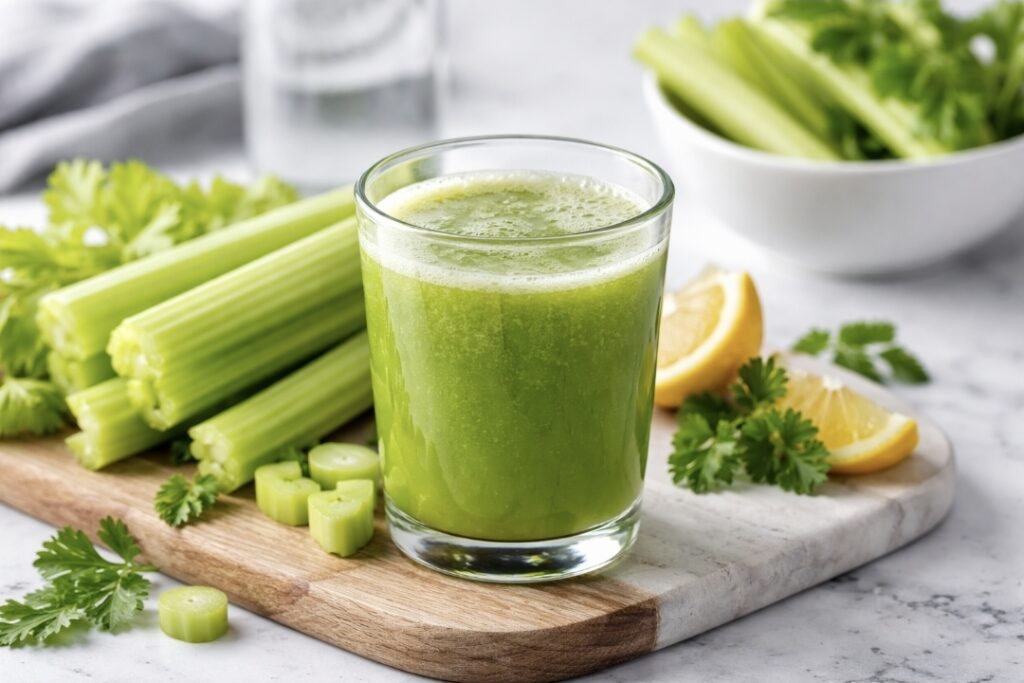
Short answer: Yes — celery juice will break a fast in the strict sense because it contains calories and nutrients that trigger digestion-related signals in the body.
But here’s the part most people get wrong: whether that matters depends on why you’re fasting. A fast for fat loss isn’t the same as a fast for autophagy, gut rest, insulin sensitivity, or religious/clean fasting rules.
So in this guide I’m going to give you the clear rules:
- When celery juice definitely breaks a fast
- When it technically breaks a fast but may still be “good enough”
- How to use celery juice without sabotaging your results

What “Breaking a Fast” Actually Means
Most people think “breaking a fast” only means “spiking insulin.” That’s too simplistic. Fasting is really about keeping the body in a low-feeding state — minimal digestion, minimal nutrient signalling, and (depending on your goal) minimal insulin response.
In practical terms, a strict fast is usually:
- No calories
- No protein
- No carbs
- No fats
That leaves you with: water, sparkling water, black coffee, plain tea, and electrolytes with no sweeteners and no calories.
Celery juice isn’t “zero.” It contains small amounts of sugar, micronutrients, and plant compounds — and it engages digestion. So by the strict definition, it breaks the fast.
Does Celery Juice Spike Insulin?
Celery juice is low calorie, but it still contains natural sugars and carbohydrates. Even a small amount of carbs can trigger a measurable insulin response in some people — especially if you’re insulin resistant, very stressed, sleep-deprived, or consuming it in a larger serving.
Also: you don’t need a “huge insulin spike” to change the internal state you’re trying to create with fasting. If your goal is to keep signalling low (especially for autophagy or a very clean intermittent fasting window), celery juice works against that.
When Celery Juice Breaks a Fast (No Debate)
If you’re fasting for any of the following, treat celery juice as breaking the fast:
- Autophagy-focused fasting (you’re trying to keep nutrient signalling as low as possible)
- Gut rest (you want minimal digestive stimulation)
- Strict “clean fast” rules (water/black coffee/plain tea only)
- Extended fasts (24h+ where even small inputs can change the response)
For these goals, keep your fasting window clean and put celery juice in your eating window. If you want a celery-focused approach, do it as a structured protocol inside your eating window (you can still use it intelligently).
When Celery Juice Might Be “Good Enough” (Dirty Fasting)
If your goal is mainly fat loss and you’re using intermittent fasting as a tool to reduce overall intake, then a small amount of celery juice may not ruin progress — but you need rules. “Dirty fasting” works when it’s controlled, not random.
Here are the dirty fasting rules that keep you honest:
- Keep it small: 100–150 ml, not a massive jug.
- No add-ons: no apple, no lemon-honey, no smoothie blends.
- One purpose only: hydration, electrolytes, or appetite control — not “because it tastes nice.”
- Track reality: if it triggers hunger, it’s not helping.
If celery juice makes you hungrier, it’s a net loss. Many people find that any taste or digestion “kick-start” makes fasting harder. If that’s you, keep it out of the fasting window.
What If I’m Doing 16:8 or 18:6?
In a typical 16:8 or 18:6, you’ll get more benefit from making your fasting window simple and consistent. The easiest strategy is:
- Fasting window: water, black coffee, plain tea (and optional zero-calorie electrolytes)
- Eating window: celery juice included if you want it
If you want a celery routine, start your eating window with it. That gives you consistency without contaminating the fast.
If you’re new to intermittent fasting, this beginner guide is your foundation:
Does Celery Juice Help You Fast Longer?
Sometimes. People use celery juice because:
- It feels hydrating and “settles” the stomach
- It can reduce cravings for some people
- It provides electrolytes (small amounts)
But it can also do the opposite and make fasting harder by triggering appetite. The only rule that matters is outcome: if it makes your fast easier without turning your fasting window into a snack window, it might be useful. If it triggers hunger, it’s out.
Best Way to Use Celery Juice (Without Sabotaging Your Fast)
Here’s the clean, repeatable approach that works for most people:
- Keep celery juice inside your eating window (ideally as the first thing you consume when you break your fast).
- Pair it with a real meal within 30–60 minutes so you don’t end up grazing.
- Use a consistent serving size so your results are measurable.
If you want celery recipes that actually taste good, start here:
And if you’re exploring celery more broadly (benefits, weight loss, detox claims, and blood pressure), use the hub as your main reference point: https://www.juicefastingforlife.com/celery-juice-benefits-does-it-really-help-weight-loss-detox-blood-pressure/
Does It Matter Why You’re Fasting? Four Specific Answers
Will celery juice break a fast for autophagy?
Yes — if autophagy is your priority, keep fasting truly clean (water, black coffee, plain tea). Put celery juice in the eating window.
Will celery juice break a fast for weight loss?
Technically yes, but small amounts may still allow fat loss if total intake stays controlled. If it makes you hungry, it’s not worth it.
What about lemon in celery juice?
Lemon adds more flavour and more digestive signalling. If you’re trying to keep a clean fast, don’t add it during the fasting window.
What can I drink during a fast instead?
Water, sparkling water, black coffee, plain tea, and (optionally) zero-calorie electrolytes with no sweeteners.
Keep This Simple (And Stop Guessing)
If fasting keeps turning into guesswork, use a simple structure you can repeat. I keep it practical (no fluff): what to drink, when to eat, and how to stay consistent without obsessing.
Celery Juice and Fasting: The One Rule That Covers Both Cases
Celery juice breaks a fast in the strict sense. If you’re fasting for autophagy, gut rest, or a clean fasting window, keep it out.
If you’re fasting mainly for fat loss and adherence, a small controlled serving might be workable — but only if it doesn’t trigger hunger or turn your fasting window into a slippery slope.
If you’ve got questions, drop them below — and if you’re building a celery routine, use the hub as the backbone: https://www.juicefastingforlife.com/celery-juice-benefits-does-it-really-help-weight-loss-detox-blood-pressure/